
What Is DR in SEO? Domain Rating
Sharing is Caring!

What Is DR in SEO?
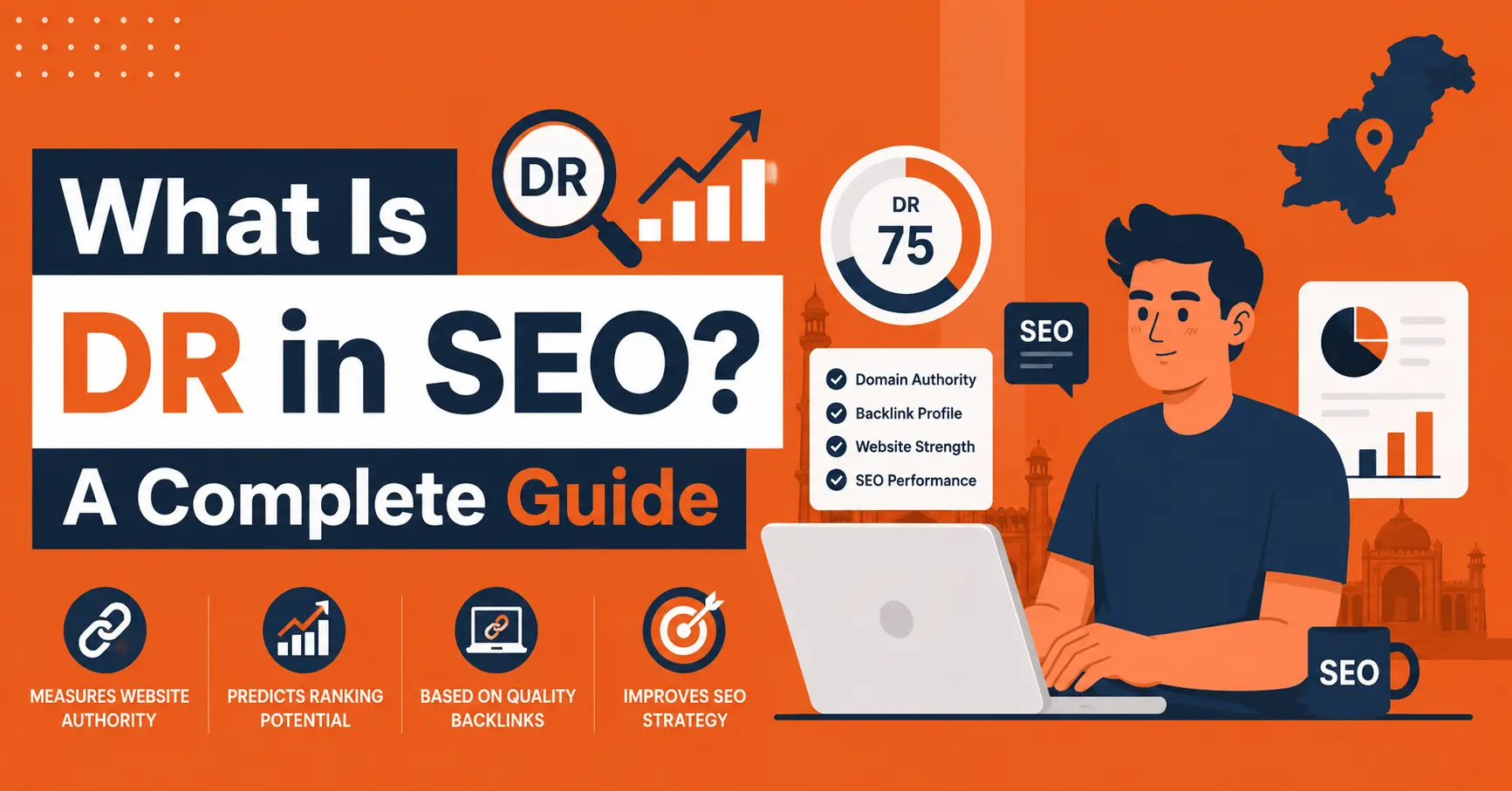
DR stands for Domain Rating — a metric created by the SEO tool Ahrefs that scores how strong a website’s backlink profile is, on a scale from 0 to 100. A higher number generally means more, and stronger, websites are linking to that domain.
That’s the simple definition. The more useful thing to understand is what DR actually measures, what it doesn’t, and why a lot of content written about it — including some higher-ranking pages on this exact topic — blurs an important distinction that’s worth getting right.
What DR Actually Measures?
DR looks at your website’s backlink profile as a whole and estimates its strength based on a few factors: how many different websites link to you, how strong those linking websites are themselves, and how selectively those websites link out (a site that links to five other sites passes more authority than one linking to thousands).
The result is a single number from 0 to 100 that’s useful for one specific thing: comparing the relative backlink strength of different websites. It’s a benchmarking tool, not a scientific measurement of SEO performance as a whole.
The Common Misconception Worth Correcting
Here’s where a fair amount of content on this exact topic gets a little loose with the truth: DR is sometimes described as something that directly “influences your ranking” or that search engines use to rank websites. That’s not accurate, and it’s worth being precise about, since it changes how much attention DR actually deserves.
DR is a third-party metric built by Ahrefs. Google has never confirmed using DR, Domain Authority, or any similar third-party authority score as a ranking factor, and Ahrefs’ own documentation is honest about this. What actually happens is a correlation: websites with strong, genuine backlink profiles do tend to rank well, and DR is one imperfect way of estimating backlink strength — but that’s different from DR itself being something Google measures or uses.
The distinction matters because it changes what you should actually be doing. If DR directly caused rankings, chasing a higher DR number would be a legitimate strategy on its own. Since it doesn’t, chasing the number itself — through bulk link purchases or artificial link schemes — can actually hurt you, since Google evaluates the genuine relevance and quality of links, not a proxy score built by a third-party tool.
The Logarithmic Scale (Why DR 20 to 30 Is Easier Than DR 70 to 80)
DR isn’t measured on a simple linear scale. Moving from DR 20 to DR 30 typically takes far less effort than moving from DR 70 to DR 80, because the scale is logarithmic — each additional point at the higher end represents a proportionally larger jump in actual backlink strength. This is why a small, newer website can often raise its DR relatively quickly at first, while an already-established site sees its DR plateau even with continued link-building work.
DR vs. Domain Authority — Are They the Same Thing?
Domain Rating (Ahrefs) and Domain Authority, or DA (Moz), aim to measure something similar — overall backlink strength — but they’re calculated differently and pulled from different backlink databases, so the same website can show a meaningfully different score on each. Neither is a Google metric; both are third-party estimates built by different companies using their own data and formulas. Comparing a site’s DR to a competitor’s DA isn’t a fair comparison, since the two scales aren’t built the same way.
Should You Actually Care About Your DR?
In moderation, yes — it’s a genuinely useful benchmarking tool. Checking your DR against direct competitors can give you a rough sense of where your backlink profile stands. Watching it rise over time, alongside other signals, can indicate that a genuine link-building or content strategy is working.
Where it becomes a problem is when DR becomes the goal itself rather than a signal. A high DR built through bulk-purchased or irrelevant links doesn’t translate into real rankings or real traffic, since Google isn’t evaluating the number — it’s evaluating the actual relevance and quality of what’s linking to you. A site with a modest, genuinely relevant DR 35 backlink profile will often outperform a site with an artificially inflated DR 60 built on low-quality links.
The Practical Takeaway
Treat DR as a mirror, not a scoreboard. It reflects the state of your backlink profile — it doesn’t create your rankings. The right goal is building genuine authority through relevant, earned links and strong content; a healthy DR tends to follow as a natural side effect of that work, not the other way around.
FAQs
What’s considered a good DR score?
It depends heavily on your industry and how established your competitors are. Roughly, DR 0–20 is typical for newer or smaller sites, 20–70 for growing or established sites, and 70+ for large, highly authoritative sites — but comparing your DR to direct competitors in your specific niche is far more useful than judging it against these general ranges alone.
Does Google use Domain Rating to rank websites?
No. DR is a third-party metric created by Ahrefs. Google has not confirmed using DR, Domain Authority, or any similar third-party score in its ranking algorithm. The correlation between high DR and strong rankings exists because both tend to reflect genuinely strong backlink profiles, not because Google reads the DR number itself.
Can I buy backlinks to increase my DR quickly?
You can, but it’s a genuinely risky approach. Bulk-purchased or low-quality links can raise a DR number without improving real rankings, and this kind of link scheme carries real risk of a Google penalty. A lower, genuinely earned DR is a healthier foundation than an inflated one built on risky links.
How often does DR update?
Ahrefs typically recalculates DR every few days as it recrawls the web and updates its backlink index, so it’s not a real-time figure — small fluctuations are normal and not usually worth reacting to individually.